Table of Contents
ToggleWhy Build a Permaculture Swale for Rainwater?
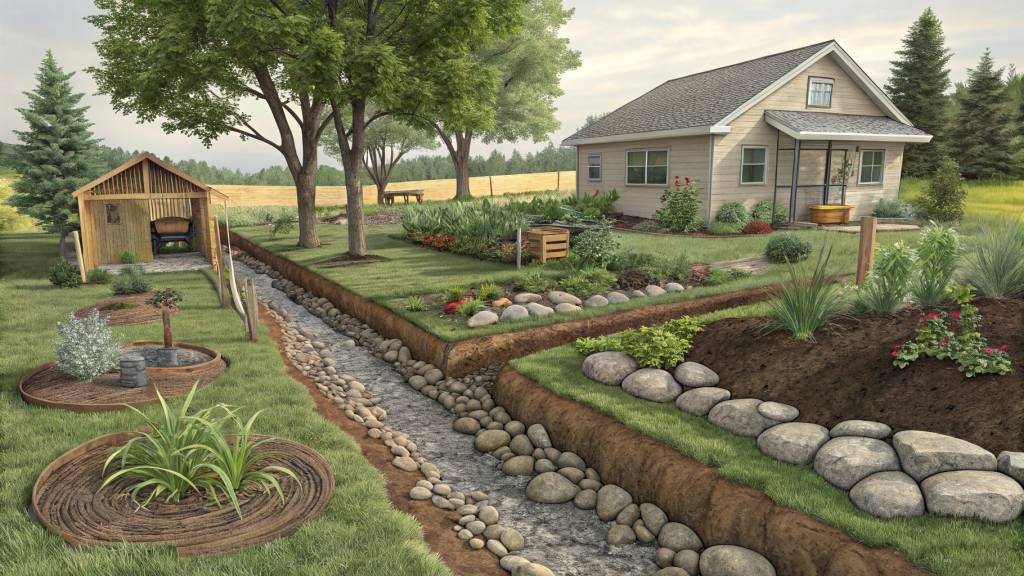
If you want to capture rainwater and build healthy soil without pumps or tanks, a permaculture swale rainwater system is your answer. A swale is a shallow trench dug on contour that slows, spreads, and sinks rainwater into the ground. Instead of letting stormwater run off your property, you can turn it into a resource that hydrates trees, shrubs, and garden beds for weeks after a rain.
Planning Your Swale
Find the Contour Lines
Swales must be level to work. Use a simple A-frame level or a line level to mark contour lines across your slope. Walk the area and place flags every 10–15 feet along the same elevation.
- Tools needed: Two 4-foot stakes, string, a line level, and flagging tape.
- Tip: Work on a gentle slope (2–10% grade). Steeper slopes require more careful design and may need terraces.
Choose the Right Location
Place swales where water naturally flows—below a driveway, at the base of a slope, or along a garden edge. Avoid areas near building foundations (at least 10 feet away) and underground utilities. Ideal siting is where you want to grow fruit trees or perennial vegetables.
Digging the Swale
Mark and Excavate
Once contour lines are marked, dig a trench 1–2 feet deep and 2–3 feet wide. The width can vary based on your space and rainfall. Pile the excavated soil on the downhill side to create a berm. The berm is where you’ll plant trees and shrubs.
- Depth: At least 1 foot deep to hold water during heavy rains.
- Length: As long as your slope allows; even a 20-foot swale can capture hundreds of gallons per storm.
Shape the Berm
Compact the berm gently with your foot or a tamper. Shape it with a flat top, about 2 feet wide, so it doesn’t erode. The berm should be slightly lower than the trench bottom to allow overflow to spill safely into the next swale or a rain garden.
Planting the Swale System
Choose Deep-Rooted Plants
The berm is perfect for water-hungry plants like fruit trees (apple, pear, plum), berry bushes, and nitrogen-fixing shrubs (e.g., goumi, sea buckthorn). On the uphill side of the swale, plant ground covers and grasses to slow runoff further.
- Berm plants: Comfrey, mint (in containers), strawberries, or perennial vegetables like asparagus.
- Swale bottom: Leave bare or plant water-tolerant species like cattails or sedges if you have consistent moisture.
Mulch Heavily
Cover the entire swale and berm with 4–6 inches of wood chips, straw, or leaf mulch. Mulch reduces evaporation, suppresses weeds, and feeds soil life. Over time, the swale will become a rich sponge that holds water longer.
Maintenance and Troubleshooting
After Heavy Rains
Check for erosion or overflow channels. If water breaches the berm, widen the swale or add a rock overflow spillway. Rebuild any low spots on the berm with additional soil.
Seasonal Care
In spring, remove debris that might block water flow. In fall, add more mulch to protect the soil. Every 2–3 years, you may need to deepen the swale if sediment builds up.
- Signs of a working swale: No standing water after 48 hours, lush vegetation on the berm, and no runoff leaving the site.
Practical Takeaway
A single permaculture swale can transform a dry slope into a thriving oasis. By capturing rainwater where it falls, you reduce irrigation needs, prevent erosion, and build fertile soil. Start small—a 10-foot swale with a few fruit trees—and expand as you see results. Your yard will thank you.