Table of Contents
ToggleWhy You Need a Pallet Compost Sifter DIY
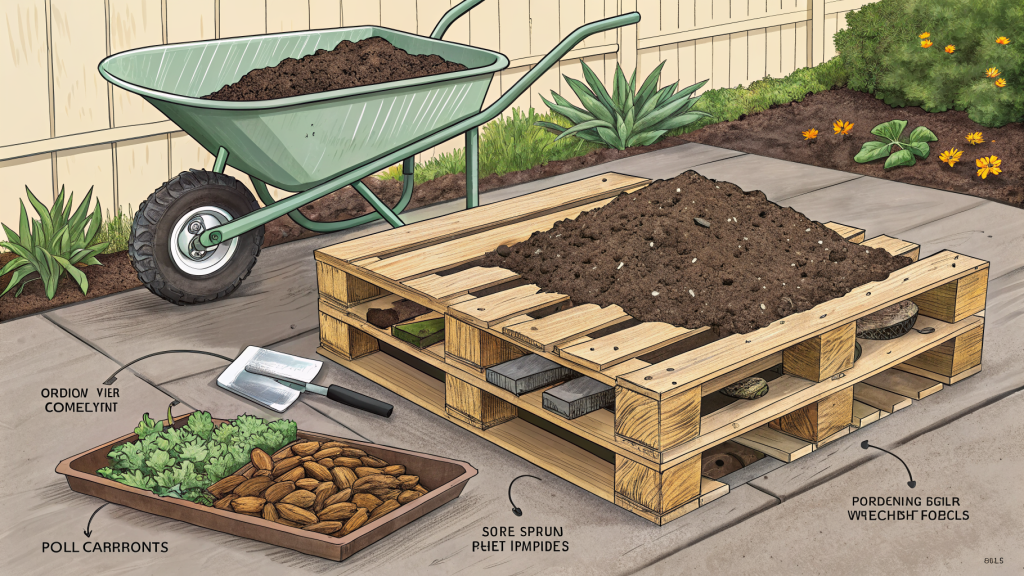
Homemade compost is a gardener’s gold, but it often contains lumps, twigs, and unfinished bits. A pallet compost sifter DIY lets you quickly refine your compost into a uniform, crumbly texture that’s perfect for seed starting, potting mixes, and topdressing. With just one pallet and a few minutes, you can build a tool that transforms your compost quality.
Materials & Tools
You need only a few items, most of which you likely already have:
- One wooden pallet (standard 40×48 inch works well)
- Hardware cloth or wire mesh with ½-inch openings
- Staples (heavy-duty, for attaching mesh)
- Staple gun or hammer & nails
- Safety glasses and gloves
- Optional: Saw (to cut pallet if needed)
Choose a pallet without chemical treatments (look for “HT” stamped on the wood).
Step-by-Step Build
1. Prepare the Pallet
- Check the pallet for loose boards or protruding nails; remove or hammer them down.
- If the pallet is wider than your desired sifter size, cut it to a manageable length using a saw. A 3×2 foot section is ideal for most wheelbarrows.
2. Attach the Mesh
- Lay the pallet flat with the top slats facing up.
- Cut a piece of hardware cloth to cover the entire top surface, plus a few inches overhang on each side.
- Position the mesh over the pallet. Starting at one edge, staple the mesh securely to the wooden frame. Space staples every 4-6 inches.
- Pull the mesh taut as you work to prevent sagging. Fold any excess mesh over the sides and staple down.
3. Reinforce the Edges
- For extra durability, add a second row of staples along each edge.
- If the mesh edges are sharp, cover them with duct tape or a thin strip of wood to prevent snagging.
That’s it – your sifter is ready in under 10 minutes.
How to Use Your Sifter
Place the sifter over a wheelbarrow, garden cart, or large tub. Shovel compost onto the mesh, then shake or agitate the pallet. The fine material falls through, while larger pieces remain on top. Use a gloved hand to break up clumps, or set aside the oversize for another compost cycle.
Tips for efficient sifting:
- Sift when compost is slightly moist but not wet – dry compost dusts, wet compost clogs mesh.
- Work in small batches (a few shovelfuls at a time).
- Tap the frame gently to help material pass through.
Benefits of Uniform Compost
Sifted compost offers several advantages:
- Better seed starting: Fine texture allows tiny roots to penetrate easily.
- Improved potting mix: Mix with sand or perlite for a consistent growing medium.
- Even topdressing: Spreads smoothly over lawns or garden beds without lumps.
- Faster decomposition: Removing large pieces lets the remaining compost break down more uniformly.
Maintenance & Storage
Your pallet sifter is built to last. Store it upright against a wall or under cover to protect from rain. If the mesh rusts or tears, simply remove the old staples and replace the hardware cloth. The wood can be oiled annually to prevent cracking.
Practical Takeaway
With this pallet compost sifter DIY, you’ll upgrade your compost from rough to refined in minutes. No power tools, no expensive materials – just a sturdy sifter that pays for itself with every batch of beautiful, uniform soil. Build one today and feel the difference in your garden.