Table of Contents
ToggleWhy Make Your Own Pyrethrin Natural Insecticide Homemade?
If you’re looking for a powerful yet gentle way to manage pests in your garden, a pyrethrin natural insecticide homemade from chrysanthemum flowers is an excellent choice. Pyrethrins are compounds found in the flower heads of certain Chrysanthemum species (especially Chrysanthemum cinerariaefolium). They quickly paralyze insects on contact but break down rapidly in sunlight, making them safer for beneficial insects when used correctly. By growing your own flowers and extracting the active ingredients, you gain full control over your pest management—no synthetic chemicals, no mystery ingredients.
Understanding Pyrethrin: How It Works
Pyrethrins attack the nervous system of insects, causing immediate paralysis. They are effective against aphids, thrips, whiteflies, leafhoppers, caterpillars, and many beetles. However, they are non-selective, so avoid spraying when bees are active. Because pyrethrins degrade quickly (within a day or two in sunlight), they have low persistence and minimal impact on the environment. For your homemade version, you’ll be extracting a crude mixture that also contains other plant compounds that can enhance effectiveness.
What You Need to Know Before Starting
- Plant selection: The highest pyrethrin content is in dried flower heads of Chrysanthemum cinerariaefolium (Dalmatian pyrethrum). You can also use Chrysanthemum coccineum (painted daisy) or Tanacetum cinerariifolium. Grow them in full sun with well-drained soil.
- Harvesting time: Pick flowers when they are fully open but before they start to wilt. Morning harvest is best after dew has evaporated.
- Drying: Spread flowers in a single layer in a warm, dark, well-ventilated area for 1–2 weeks until completely crisp. Store dried flowers in an airtight jar away from light.
Step-by-Step Extraction of Pyrethrin Natural Insecticide Homemade
This simple extraction uses common household items. The result is a concentrate that you’ll dilute before spraying.
What You’ll Need
- 1 cup (about 30–40 grams) dried chrysanthemum flowers
- 1 quart (4 cups) of 70% isopropyl alcohol (or high-proof vodka like 80–100 proof)
- A glass jar with a tight-fitting lid
- Cheesecloth or a fine mesh strainer
- A dark glass bottle for storage
Extraction Process
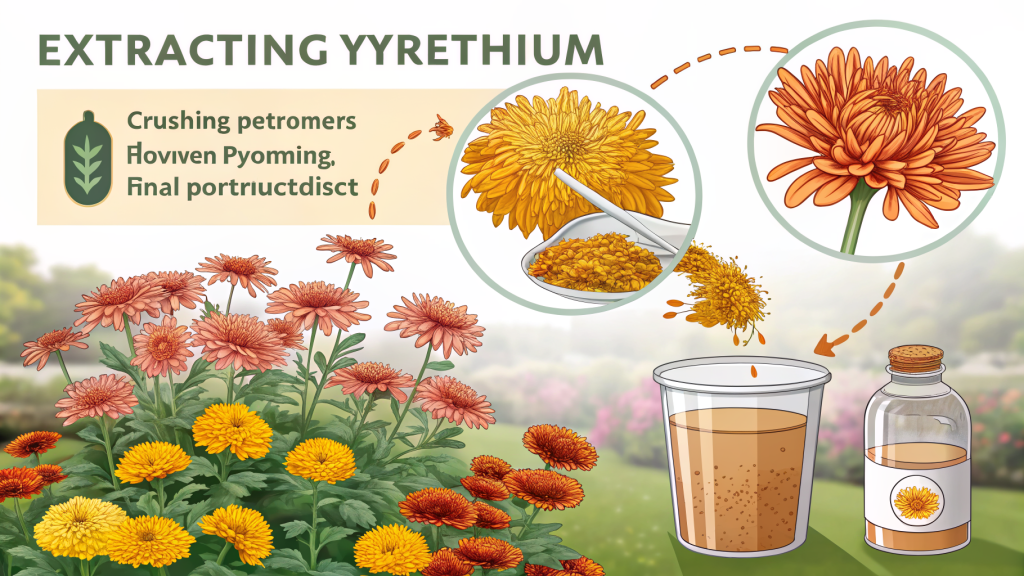
- Crush the flowers: Place dried flowers in a clean coffee grinder or mortar and pestle. Grind to a coarse powder—not too fine, as you’ll need to strain later.
- Combine with alcohol: Put the ground flowers in the glass jar and pour the alcohol over them. Seal the jar tightly and shake gently to ensure all plant material is wet.
- Steep for 24–48 hours: Store the jar in a cool, dark place. Shake it once every 8–12 hours. The alcohol will dissolve the pyrethrins and other active compounds.
- Strain the mixture: Line a strainer with cheesecloth and pour the contents through. Squeeze the cloth to extract as much liquid as possible. Discard the spent flowers.
- Filter for clarity (optional): If you want a clearer solution, strain again through a coffee filter. This step isn’t necessary for effectiveness.
- Store in a dark bottle: Transfer the liquid to a dark glass bottle. Label it clearly with contents and date. This concentrate can be stored for up to one year if kept away from light and heat.
How to Use Your Homemade Pyrethrin Spray
Your extract is a concentrate. Always dilute it before applying to plants to avoid leaf burn. The typical dilution ratio is 1 part concentrate to 10–20 parts water (start with 1:20 for delicate plants).
Mixing and Application
- Test first: Spray a small area of the plant and wait 24 hours to check for any damage.
- Mixing: Add 1–2 tablespoons of concentrate per quart of water (or 60–120 ml per 4 liters). Add a few drops of mild liquid soap (like castile soap) as a surfactant to help the spray adhere to leaves.
- Spraying: Use a clean spray bottle and apply thoroughly to all plant surfaces, especially the undersides of leaves where insects hide. Spray in the early morning or late evening to avoid harming bees and to reduce evaporation.
- Repeat as needed: Because pyrethrins break down quickly, reapply every 5–7 days or after rain. Stop spraying once pests are under control.
Safety Precautions and Storage Tips
While natural, pyrethrin can still irritate skin and eyes. Always wear gloves and eye protection when handling the concentrate. Avoid inhaling the spray mist. Keep the concentrate out of reach of children and pets. Store your concentrate in a cool, dark place—exposure to light and heat will degrade the active compounds. If you notice a change in smell or color, it’s time to make a fresh batch.
Practical Takeaway
Growing your own pyrethrum flowers and making a pyrethrin natural insecticide homemade is a rewarding way to manage garden pests sustainably. This extraction method yields a potent concentrate that, when diluted and used responsibly, offers effective control without leaving harmful residues. Start with a small batch, observe how your plants respond, and adjust your approach. With a little practice, you’ll have a reliable, homemade tool for a healthier garden.