Table of Contents
ToggleWhy the Hilling Method Works for Small Spaces
If you want to grow potatoes raised bed style but think you need acres, think again. A standard 4×4 raised bed can yield up to 50 pounds of potatoes when you use deep soil hilling and choose the right varieties. The secret lies in how potatoes form: they grow from stems, not roots. By gradually mounding soil around the stems, you encourage more layers of tuber formation, effectively multiplying your harvest in a compact footprint.
Step 1: Choose the Right Potato Varieties
Not all potatoes are equal for raised bed hilling. You want indeterminate (or “long-season”) varieties that keep producing tubers along the stem as you hill.
- Yukon Gold – reliable, buttery flavor, good for storage
- Kennebec – high yields, excellent for baking and mashing
- Red Pontiac – vigorous growth, red skin, great for roasting
- Purple Majesty – fun color, good yields, high antioxidants
Avoid determinate (early) varieties like Red Norland or Adirondack Blue for hilling methods, as they produce only one layer of tubers.
Step 2: Prepare Your 4×4 Raised Bed
Soil Mix
Potatoes need loose, well-draining soil with a pH of 5.8–6.5. Mix equal parts garden soil, compost, and perlite or coarse sand.
Bed Depth
Your raised bed should be at least 12 inches deep; 18 inches is better. This allows room for successive hilling.
Pre-Planting
- Cut seed potatoes into 1.5–2 inch pieces, each with at least two eyes.
- Let cut pieces cure for 1–2 days at room temperature to form a callus.
- Plant in early spring when soil temp reaches 45°F (7°C).
Step 3: Planting and Initial Hilling
In your 4×4 bed, dig two trenches 12 inches apart and 6 inches deep. Place seed pieces 12 inches apart in each trench, eyes up. Cover with 3 inches of soil. This initial planting uses about 8 seed pieces.
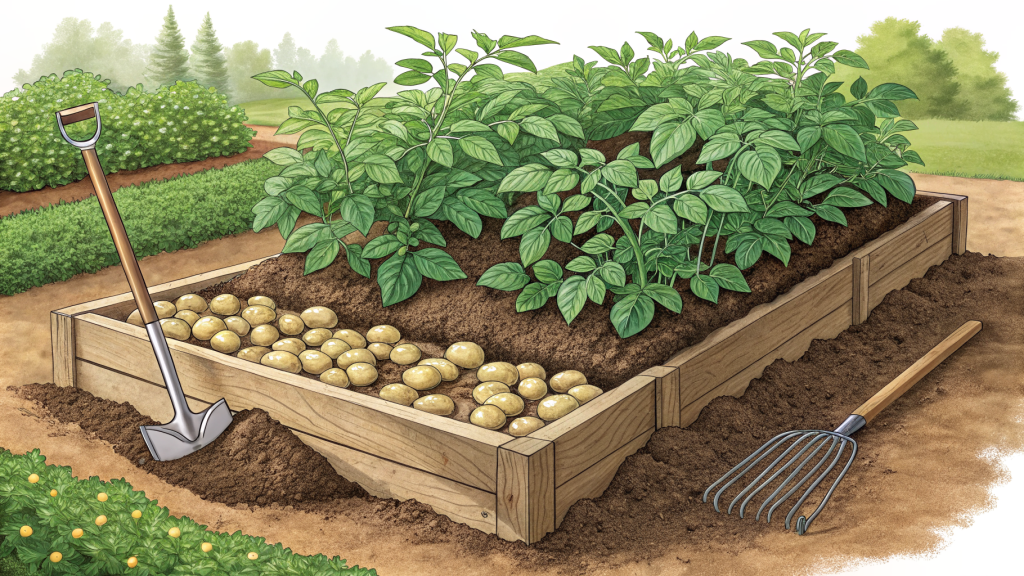
As soon as sprouts emerge (about 2 weeks), begin hilling. Use a hoe or your hands to pull soil from the sides of the bed up around the stems, leaving only the top 2–3 inches of leaves exposed. Repeat this process every 1–2 weeks until the bed is mounded about 12 inches above the original soil level.
Step 4: Hilling Schedule and Technique
When to Hill
- First hilling: when sprouts are 6 inches tall
- Second hilling: when plants are 12 inches tall
- Third hilling: when plants are 18 inches tall (or until bed is full)
How to Hill
- Use a mix of your original soil and compost (50/50).
- Water thoroughly after each hilling to settle the soil.
- Avoid covering more than one-third of the plant at a time.
By the third hilling, your 4×4 bed will be a raised mound about 18 inches high. This deep soil encourages multiple layers of tubers.
Step 5: Watering and Feeding for Maximum Yield
Consistent moisture is critical—potatoes need about 1–2 inches of water per week. Inconsistent watering causes knobby or hollow tubers.
- Water deeply once or twice a week, not daily.
- Mulch with straw after the final hilling to retain moisture and suppress weeds.
- Fertilize with a balanced 10-10-10 or a low-nitrogen formula (like 5-10-10) every 3 weeks until flowering. Too much nitrogen produces lush leaves but few tubers.
Step 6: Harvesting Your 50-Pound Bounty
Stop watering 2 weeks before harvest to allow skins to set. For new potatoes, harvest when plants flower. For full-sized storage potatoes, wait until the vines die back completely.
To harvest, gently dig around the edges of the mound with a garden fork, then pull the entire hill apart by hand. In a 4×4 bed with 8 plants, you can expect 5–7 pounds per plant—that’s 40–56 pounds total.
Practical Takeaway
To grow potatoes raised bed style and hit 50 pounds, focus on indeterminate varieties, deep initial planting, and consistent hilling every 1–2 weeks. With just 16 square feet, you can enjoy a season’s worth of homegrown spuds. Start prepping your bed now, and by mid-summer you’ll be digging up treasure.