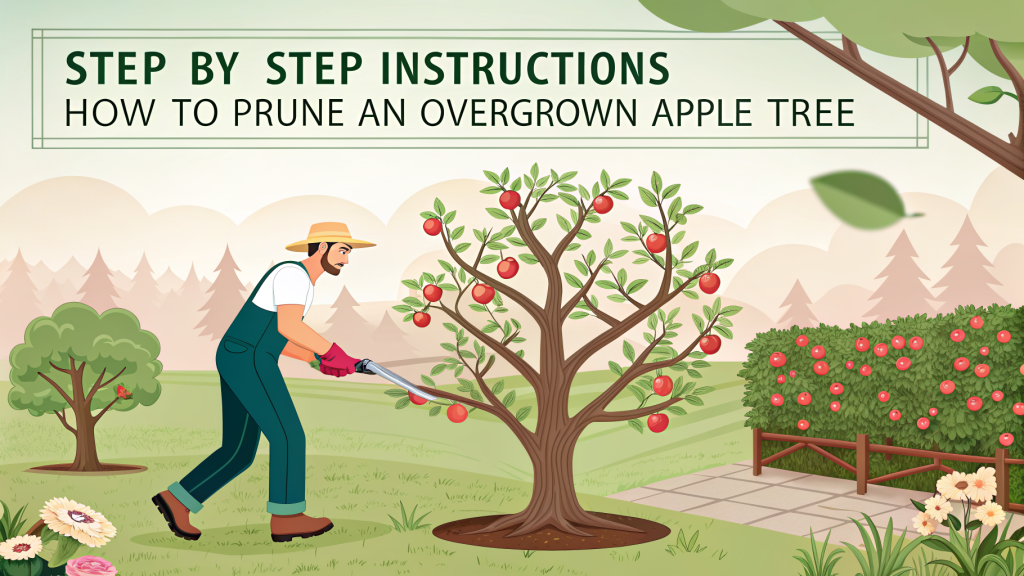
If you’ve inherited an old, overgrown apple tree that’s all tangled branches and little fruit, don’t give up on it. Learning how to prune an overgrown apple tree into a central leader form can restore its shape, health, and productivity. This three-season plan uses strategic cuts to gradually transform your tree.
Table of Contents
ToggleUnderstanding the Central Leader Form
The central leader form mimics a tree’s natural growth, with one main trunk rising straight to the top and horizontal branches radiating out in tiers. This shape allows sunlight to reach all parts of the tree, improving fruit quality and reducing disease. For an overgrown tree, the goal is to identify and preserve a strong central leader while removing competing upright branches.
Season 1: The Initial Hard Rejuvenation
Start in late winter or early spring while the tree is dormant. Make these cuts:
- Remove the dead, diseased, and damaged. Cut these back to healthy wood or the trunk.
- Eliminate crossing and rubbing branches. Choose the better-positioned one and remove the other.
- Select a central leader. Look for a strong, upright branch near the top. Remove competing vertical shoots.
- Lower the height. Cut the central leader back to a height of 8-10 feet. This forces growth into lower branches.
- Thin out congested branches. Remove up to 1/3 of the oldest, thickest branches to open the canopy.
After this season, the tree may look bare, but it will respond with vigorous new growth.
Season 2: Shaping the Scaffold Branches
In the second winter, focus on establishing the scaffold whorls—tiers of branches spaced 12-18 inches apart vertically.
Select the First Whorl
- Choose 3-4 branches at the same height, evenly spaced around the trunk.
- Remove any branches below this whorl.
- Cut back these scaffold branches to 2-3 feet from the trunk, to an outward-facing bud.
Develop Higher Tiers
- Identify the next whorl 18-24 inches above the first.
- Select 2-3 branches, again with wide crotch angles and good spacing.
- Remove branches that are too vertical or too close to the leader.
Also remove any water sprouts that grew during the first season, except for a few that may be trained as temporary fruiting wood.
Season 3: Refinement and Maintenance
By the third winter, the tree should have a clear central leader and well-spaced scaffold branches.
- Maintain the leader. If competing shoots appear, remove them.
- Thin fruiting wood. Remove weak, spindly branches and those that are too dense.
- Shorten long branches. Cut back to a lateral branch to encourage spur development.
- Remove water sprouts. Rub off any new suckers.
After three seasons, the tree will be manageable and productive. Continue annual pruning to maintain the form.
Tools and Safety Tips
- Use sharp, clean pruning shears, loppers, and a pruning saw for large cuts.
- Sanitize tools between cuts if you remove diseased wood.
- Make cuts at a 45-degree angle just above a bud or branch collar.
- Wear gloves and safety glasses.
- Never remove more than 1/3 of the canopy in a single year.
What to Expect After Pruning
The tree will produce vigorous water sprouts and vertical shoots in response to heavy pruning. Don’t panic—these can be removed in subsequent seasons. Fruit production may decrease initially, but quality and size will improve. With patience, you’ll see a healthy, productive tree within three to four years.
Practical Takeaway: Restoring an overgrown apple tree to central leader form is a three-year project. Focus on the leader first, then scaffold branches, then fine-tuning. Always prune in winter and remove no more than one-third of the canopy each year. With consistent effort, your old tree will reward you with abundant, high-quality fruit.