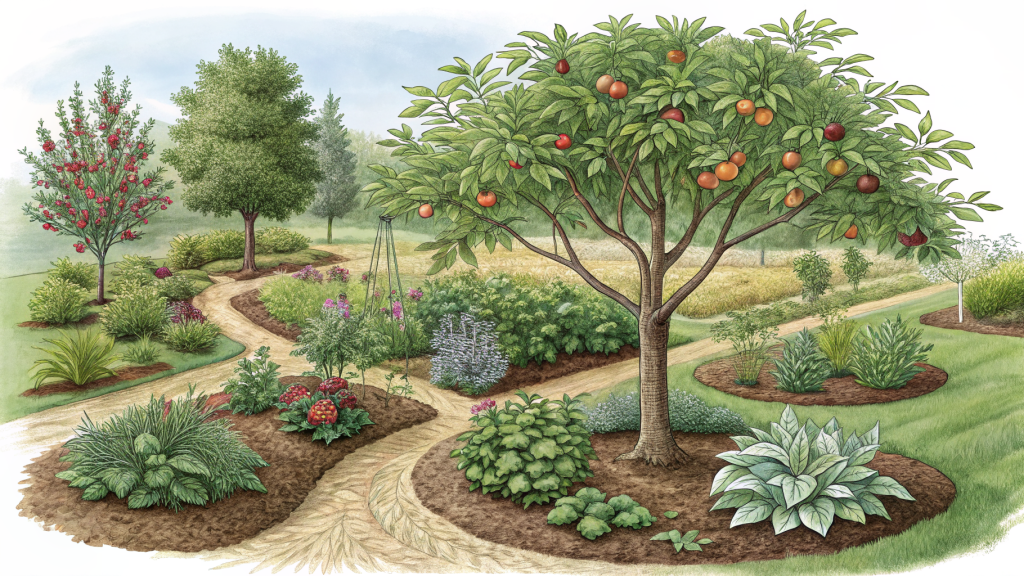
Beneath the canopy of an apple or pear tree lies an opportunity—a space primed for fruit tree guild planting. By assembling a community of companion plants that support each other and the tree, you can transform that patch of soil into a productive, resilient polyculture. This approach mimics natural ecosystems, boosting yield, improving soil health, and reducing maintenance. Let’s walk through how to design a thriving guild around your fruit trees.
Table of Contents
ToggleWhy Build a Fruit Tree Guild?
A fruit tree guild is a group of plants intentionally placed around a central tree to perform specific functions: fixing nitrogen, accumulating nutrients, attracting pollinators, repelling pests, suppressing weeds, and providing mulch or food. Unlike monoculture orchards, a polyculture creates a closed-loop system where waste becomes resource. The tree benefits from reduced competition and enhanced nutrient cycling, while you enjoy a diverse harvest with less work.
Key Functions in a Guild
Every plant in your guild should serve at least one of these roles. A well-designed guild has redundancy—multiple plants performing each function for resilience.
Nitrogen Fixers
These plants partner with soil bacteria to convert atmospheric nitrogen into a form usable by plants. They fuel leaf growth and overall tree vigor.
- Ground cover: White clover (Trifolium repens) or strawberry clover—low-growing, tolerates shade, and fixes nitrogen.
- Shrub layer: Goumi berry (Elaeagnus multiflora) or autumn olive—both fix nitrogen and produce edible fruit.
- Herbaceous: Lupine or vetch—annuals that can be cut back for mulch.
Dynamic Accumulators
Deep-rooted plants that mine minerals from deep in the soil and bring them to the surface via their leaves. When they drop or are cut, they release those nutrients.
- Comfrey (Symphytum officinale)—the champion accumulator. Plant it at the drip line; chop and drop leaves several times a season.
- Dandelion—taproot brings up calcium and potassium; also attracts pollinators.
- Yarrow—accumulates copper, potassium, and phosphorus; also beneficial for pest control.
Pollinator Attractors
More pollinators mean better fruit set. Include plants that bloom before, during, and after the tree’s flowering period.
- Spring bulbs: Crocus, grape hyacinth—bloom before apple blossoms.
- Early summer: Borage, lavender, and lemon balm—highly attractive to bees.
- Late season: Echinacea, goldenrod—support pollinators after tree bloom.
Pest Confusers & Repellents
Certain plants deter common fruit tree pests through scent or by harboring beneficial insects.
- Aromatic herbs: Mint, tansy, and wormwood—repel ants and aphids. Plant in containers to prevent spreading.
- Dill and fennel—attract parasitic wasps that prey on codling moth larvae.
- Nasturtium—trap crop for aphids; draws them away from the tree.
Ground Covers & Mulch Producers
Living mulch protects soil, retains moisture, and suppresses weeds. Some plants also provide abundant chop-and-drop material.
- Clover (as above)—excellent living mulch.
- Sweet woodruff—shade-tolerant, forms a dense mat.
- Oregano—spreads readily, attracts pollinators, and can be harvested for kitchen use.
Designing Your Guild: Step by Step
Follow these steps to create a layout that works with your tree’s size, light, and root zone.
1. Assess Your Tree
- Note the variety (apple or pear), rootstock (determines size), and age.
- Measure the drip line—the outermost reach of the branches. This is where most feeder roots are.
- Observe sunlight patterns. Under a full-size tree, shade can be dense; choose shade-tolerant plants.
2. Define Zones Around the Trunk
- Inner ring (0–2 ft from trunk): Keep clear of plants to avoid root competition and rot. Use mulch only.
- Middle ring (2–4 ft): Plant low-growing dynamic accumulators and ground covers like comfrey (set back 2 ft) and clover.
- Outer ring (drip line and beyond): Add nitrogen-fixing shrubs, taller pollinator plants, and pest-repelling herbs.
3. Layer Plants Vertically
Think in layers: canopy (the tree itself), understory shrubs, herbaceous perennials, and ground covers. This maximizes space and creates diverse habitats.
- Shrub layer: Goumi berry or currants (partial shade tolerant).
- Herbaceous layer: Comfrey, yarrow, borage, dill.
- Ground cover: Clover, creeping thyme, or sweet woodruff.
4. Plant in Succession
Start with the tree well-established (at least 2 years old) before adding guild plants. Introduce plants gradually to observe interactions.
Maintaining Your Guild
A guild is not “no-maintenance,” but it requires less work than a conventional orchard floor. Key tasks:
- Chop and drop comfrey, yarrow, and other accumulators 2–3 times per season. Leave cuttings as mulch.
- Weed out aggressive plants that outcompete tree or desired guild members. Mint and tansy may need containment.
- Water during drought until the guild is established (first year). Afterward, the mulch and ground cover retain moisture.
- Monitor for pests and adjust plantings. If aphids appear, add more dill or fennel to attract wasps.
Sample Guild for an Apple Tree (Zone 6–8)
Here’s a ready-to-use combination for a semi-dwarf tree (8–12 ft tall).
- Inner ring: Mulch with wood chips (keep 1 ft from trunk).
- Middle ring: 3 comfrey plants, white clover as living mulch, and a ring of chives (repel aphids).
- Outer ring: 1 goumi berry shrub (north side, partial shade), yarrow, borage, and dill scattered around.
- Seasonal add-ons: Nasturtium seeds sown in spring at drip line (trap crop).
Practical Takeaway: Start small—choose 3–5 plants that fulfill different roles and observe how they interact. You can always expand. The goal is not perfection but a resilient, self-sustaining system that rewards you with healthier trees and a more abundant harvest.